
Cold outreach is harder than it was two years ago. Average reply rates fell to 5.8% in 2024, down from 6.8% in 2023, according to Belkins’ 2025 analysis of 16.5 million B2B emails. Roughly 19 out of 20 cold emails go ignored. The problem is rarely the channel. It’s the quality of the approach.
Research consistently shows that personalized outreach outperforms generic blasts by a wide margin: emails with personalized subject lines achieve open rates of 46%, compared to 35% for non-personalized ones. The gap between “good” and “sent” has never been wider.
The 3×3 rule is one practical answer to that gap. It’s a discipline: gather three meaningful pieces of intelligence about a prospect in under three minutes, then use that intelligence to open a conversation that sounds like a conversation, not a broadcast.
Simple in concept, powerful in execution, and easily overlooked by reps who have thirty names to work through before noon.
Why personalization is a revenue lever, not a courtesy
Belkin’s 2025 study of 16.5 million B2B cold emails found that personalized subject lines drove open rates of 46% versus 35% for generic ones, a 31-point lift in visibility before a single word of the body is read.
Multi-point personalization, where messages reference specific details like a company’s recent news or a prospect’s role context, boosts reply rates by up to 142%, according to Woodpecker’s analysis of cold email data.
The cost of skipping personalization is equally measurable. Sales reps spend roughly 60% of their time on non-selling tasks like data entry, internal meetings, and administrative work, according to Salesforce’s 7th Edition State of Sales report.
Adding hours of manual prospect research on top of that creates an unsustainable trade-off. The 3×3 rule threads the needle: enough context to write something relevant, fast enough to keep volume intact.
What the rule actually requires
The mechanics are deliberately minimal. Before reaching out to any prospect, spend no more than three minutes surfacing three facts that are relevant to why you’re contacting them. These three pieces of information should belong to one of three categories.
Role context
What does this person actually do, and what problems come with that role? A VP of Operations at a mid-size manufacturing firm has different pressures than a CMO at a SaaS startup. Understanding the job shapes which pain points to lead with.
Recent company activity
A funding round, product launch, acquisition, leadership change, or expansion into a new market is a signal. They indicate the company’s current priorities and where a well-timed message might land.
A personal signal
A post shared on LinkedIn, a panel they spoke on, and an article they published. Even a brief, authentic reference to something the prospect has publicly said demonstrates that the message was written for them specifically.
Three minutes. Three facts. That’s the constraint. The time limit isn’t arbitrary. It prevents research from becoming a substitute for outreach.
Top-performing sales reps are more disciplined about pre-call preparation than average performers: LinkedIn’s Global State of Sales data found that 76% of top performers always research before reaching out, compared to just 47% of those who met the target.
Where to look in three minutes
The three most efficient sources, in order:
1. LinkedIn
Check the prospect’s title, tenure, and recent activity. Posts, comments, and reposts reveal what they’re paying attention to right now. A director who’s been sharing articles about supply chain resilience for three weeks is signaling something about their headspace.
2. Company website
Scan the news or blog section for anything published in the last 90 days. Product launches, press mentions, case studies, and hiring announcements all signal direction. Three recent job listings for logistics coordinators suggest something is scaling.
3. A quick search
A targeted Google or news search combining the company name with a term like “funding,” “expansion,” or “award” can surface context that doesn’t live on the company’s own properties. One minute on Google beats five minutes going deep on a blog that hasn’t been updated since 2022.
Once those three facts are captured, log them in your CRM immediately. Storing research as you gather it builds a prospect-level context file that pays dividends across every follow-up, not just the first touch.
Once you’ve gathered your 3 key insights, quickly summarize the information using AI Summarizer. Then, store these insights in your CRM or sales platform for easy reference during outreach. This allows you to maintain a record of the 3×3 research you’ve done and use it for follow-ups or future interactions.
The follow-up problem most reps overlook
The 3×3 rule applies to the first touchpoint. But personalization without persistence is wasted effort. Most B2B buyers require multiple contacts before engaging, and the research context you built at the start should inform every subsequent message.
A follow-up that echoes something specific from the first exchange, or references a new development at the prospect’s company, signals genuine interest rather than mass sequencing.
Scaling the rule with AI
The 3×3 rule works well for targeted, high-value sequences where a rep is working fifty names with above-average deal sizes. At higher volume (hundreds or thousands of contacts per month), manual three-minute research per prospect is where AI-powered outbound platforms close the gap.
Platforms like AnyBiz are built for companies that need to run intelligent outbound at scale without building a dedicated BDR team first. AI-driven outbound automates the three layers of personalization that the 3×3 rule targets manually: role-level tailoring, company-specific context drawn from real-time research, and message variation so that multiple contacts at the same organization receive distinct language.
What takes a rep three minutes per prospect, AI executes across thousands of contacts simultaneously, without sacrificing the signal that makes outreach feel considered rather than templated.
The tradeoff is straightforward: AI handles speed and coverage; humans retain judgment on strategy. The companies that see the best results from AI-driven outbound are the ones that use the first two to three months to iterate on persona-offering-messaging combinations, guided by performance data. The tool replaces the labor; the strategic thinking still belongs to the team.
How AnyBiz automates the 3×3 rule at scale
For teams that need to apply the 3×3 logic across hundreds or thousands of contacts per month, AnyBiz translates the same discipline into an automated system.
Here’s how each core feature maps to the rule:
AI-Driven Email Outreach: Three personalization layers built in
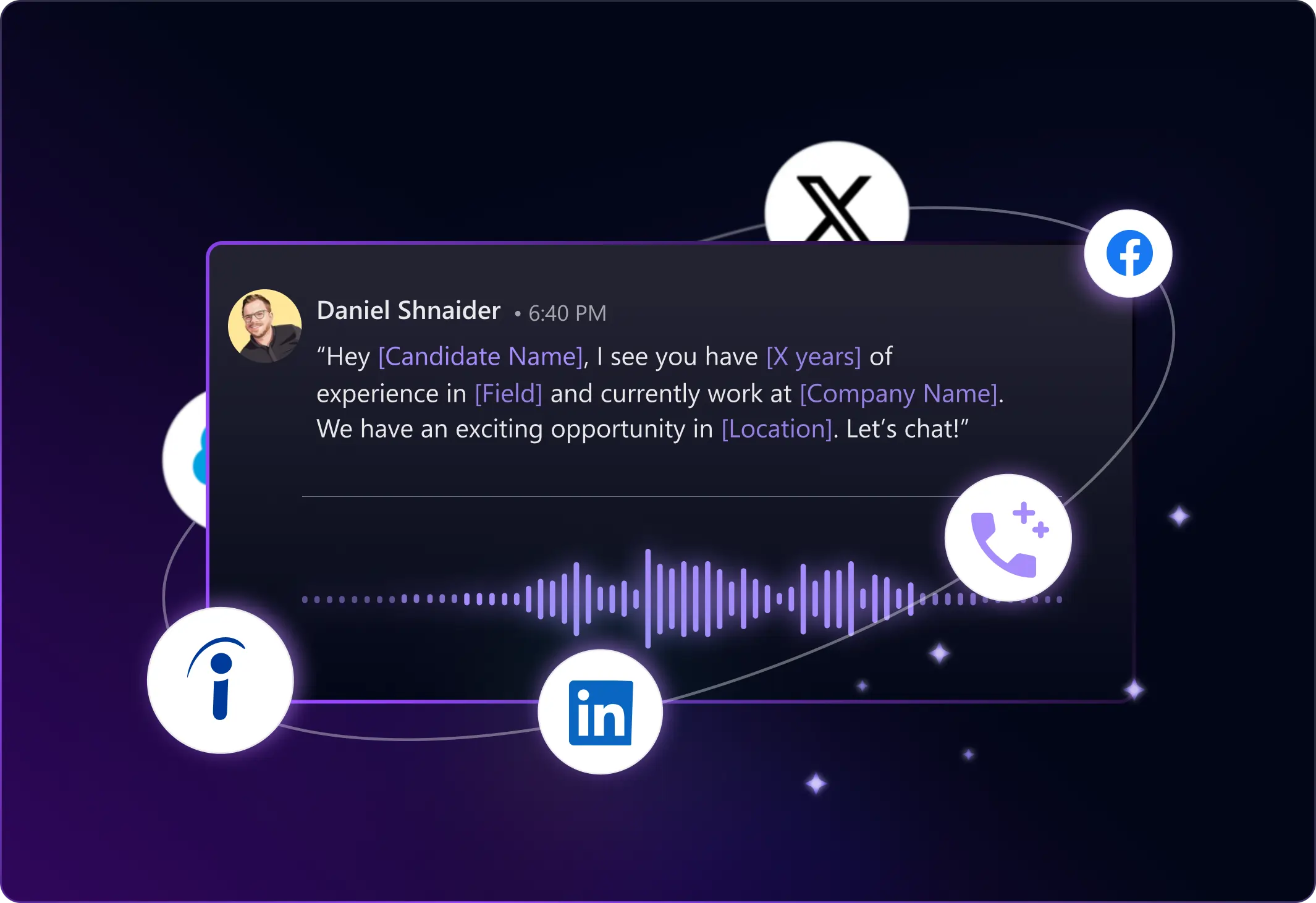
Where the 3×3 rule asks a rep to manually gather role context, company signals, and personal details, AnyBiz replicates those three layers automatically:
- Tailor: Emails are adjusted based on the recipient’s position, industry pain points, and relevant case studies, equivalent to role context.
- Personalize: Messages are further refined using real-time research about the company’s situation, equivalent to recent company activity.
- Spintax: When multiple contacts at the same organization receive outreach, each message uses varied phrasing so no two look templated, eliminating a key risk in high-volume outbound.
AI Response Management: Keeping the conversation moving
Personalized outreach creates more replies, which creates a new bottleneck: managing them. AnyBiz includes an AI response handler that classifies inbound replies (interested, not interested, out of office, wrong person) and responds automatically based on rules the user configures.
Teams decide which conversation types the AI handles and which they want to manage themselves, so high-value leads always get human attention.
AI Calling: Extending personalized outreach beyond email
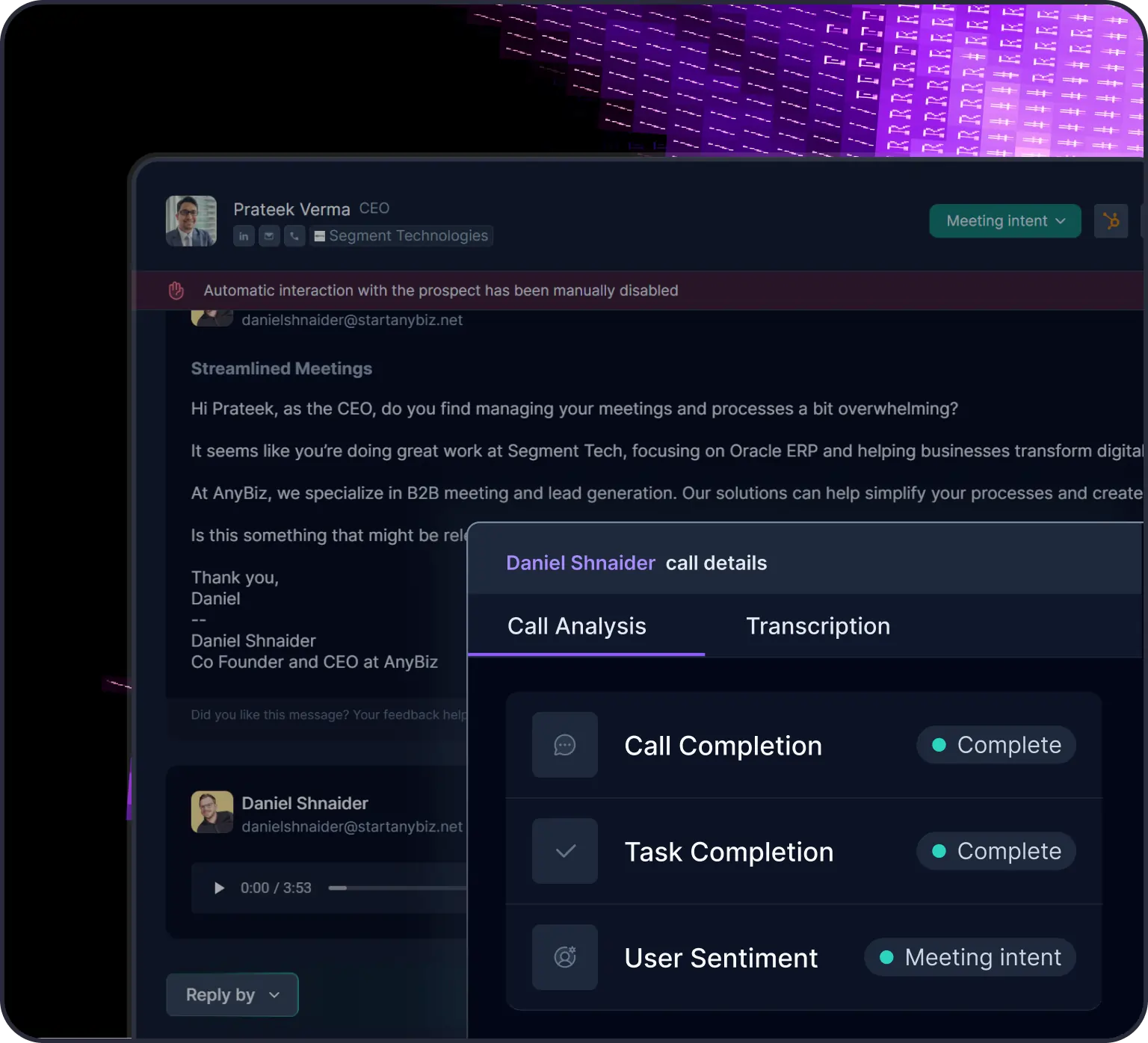
The same logic that drives email personalization extends to calling. AnyBiz automates cold calls across three standard scenarios (decision-maker, gatekeeper, voicemail), with tone customizable by segment (formal, conversational, bold, and others) and multi-language support. Users can provide a call script or instructions the AI follows, replicating the “know something real before you reach out” principle in a voice channel.
Data & Contacts: Import your own or use AnyBiz’s database
Building a target audience in AnyBiz uses standard filters: job title, department, seniority, company size, location, and industry. Teams can import their own contact lists or pull from AnyBiz’s built-in database, practical for teams who want to launch quickly without assembling a separate data stack first.
Advanced Features: Website Visitor ID, Landing Pages, and Brand Awareness
For teams that have absorbed the core outbound workflow, AnyBiz also provides website visitor identification (surfacing which companies are browsing before any outreach happens), personalized landing pages tied to individual campaigns, and brand awareness tools that extend reach beyond direct outbound.
Where the rule breaks down
The 3×3 framework isn’t universal. Three minutes of research can’t compensate for a structural problem in the outreach.
An audience that’s too narrow
If the total addressable universe is a few hundred contacts, no amount of personalization fixes the math. Volume ceilings matter.
An undifferentiated offering
Service categories where every provider sounds alike (marketing agencies, IT consultancies, recruiting firms) face a harder personalization challenge because the product itself doesn’t anchor the message. Research can open the door; what’s behind it still has to be compelling.
Research used as avoidance
Some reps spend 20 minutes per prospect under the banner of “personalization.” The 3×3 rule is partly a forcing function against this. Beyond three minutes, diminishing returns set in fast, and activity looks like thoroughness without producing more pipeline.
Conclusion
B2B inboxes are crowded, and buyers have grown adept at recognizing messages written for no one in particular. The 3×3 rule is an antidote: a structured habit that forces specificity before every outbound touch. Three facts, three minutes, one message that sounds like it was meant for the person receiving it.
For teams running high-volume outbound, the same principle scales through AI platforms that automate the research and personalization layer. Either way, the underlying discipline (know something real about the person before you reach out) is what separates outreach that opens conversations from outreach that fills up the spam folder.

FAQ
1. What exactly is the 3×3 rule in B2B prospecting?
It’s a pre-outreach research discipline: before reaching out to any prospect, you spend no more than three minutes gathering three relevant pieces of information, drawn from three categories: the prospect’s role context, recent company activity, and a personal public signal (a LinkedIn post, a panel appearance, a published article). The goal is for your message to sound like a real conversation, not a mass broadcast.
2. Why three minutes and not more?
The time limit is a control mechanism, not an arbitrary constraint. Beyond three minutes, diminishing returns kick in fast and research starts substituting for action. Some reps spend 20 minutes per prospect under the banner of “personalization” without generating more pipeline. The rule forces you to prioritize the highest-signal data in the shortest time possible.
3. How much does personalization actually move reply rates?
The impact is measurable and significant. According to Belkin’s analysis of 16.5 million B2B cold emails, personalized subject lines drive open rates of 46% versus 35% for generic ones. And per Woodpecker’s cold email data, multi-point personalization, where messages reference specific details about the prospect, can boost reply rates by up to 142%.
4. How do you scale the 3×3 rule when you’re working hundreds or thousands of contacts a month?
At that volume, manual research per prospect isn’t viable. Platforms like AnyBiz replicate the three personalization layers automatically: they tailor messages by role and industry pain points (Tailor), pull real-time company context into each email (Personalize), and vary the wording when multiple contacts at the same organization receive outreach (Spintax).
5. When does the 3×3 rule stop working?
The rule doesn’t fix structural problems. If your total addressable audience is too small, personalization won’t overcome the volume ceiling.
If your offer is undifferentiated, common in categories where every provider sounds alike, research can open the door, but what’s behind it still has to be compelling. And if the rule becomes an excuse to avoid outreach (researching instead of executing), it defeats its own purpose entirely.